

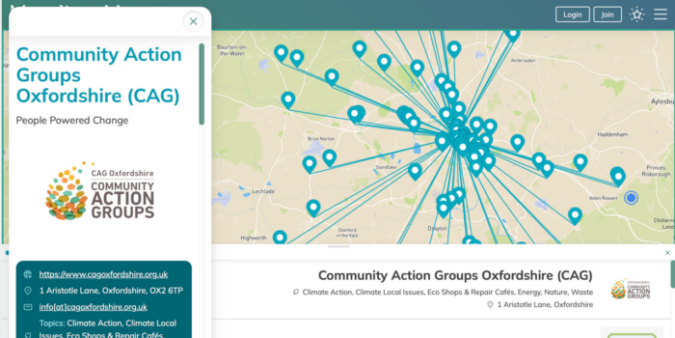
Among the attendees at this year’s SECA Annual Gathering were Anuradha Vittachi and Peter Armstrong, developers of the Mycelium Map, which seeks to create the UK’s largest database of community-led climate action, helping people find out what’s happening in their area and see what they can do to help climate and nature. This blog by Anuradha outlines the fast-growing project and explains why your group should be part of it.
Joining the Mycelium Map
The need
Despite rising public concern about climate and nature, climate action is often framed at national or global scale, disconnected from everyday life, leaving many people feeling powerless to act. If members of the public are to be mobilised, they need examples of relatable climate-nature actions happening in their own neighbourhoods, and other neighbourhoods not unlike their own.
Dr David Halpern, founder of the Behavioural Insights Team at No.10 Downing Street (the ‘Nudge Unit’), says, “The real nudges in our life aren’t from politicians, it’s from people around us – what are our workmates doing, our friends? Everyone is looking around, figuring out the norm.”
In fact, thousands of our workmates, our friends, our neighbours, local community groups across England, are undertaking climate and nature actions. But this work is fragmented and under-visible.
The response
The Mycelium Map can make it all visible. When people look at the Map, they marvel at just how many thousands of people like themselves are taking action all around them. You can see in their faces the return of hope and confidence as they realise they are not alone. Far from alone! They are surrounded by kindred spirits taking action in myriad ways relevant to every season of life – from walking buses for schoolchildren, through community energy schemes, food redistribution and nature recovery projects, all the way to eco-burials.
Apart from ‘social proof’, Dr Halpern says, the other major factor nudging the public into action is ‘ease’. People need practical information in a way that’s easy to access – and filtered to focus on what’s relevant to their needs. On the Mycelium Map, you can filter information by topic, by organisation, by distance from your location, and just on your preferred dates.
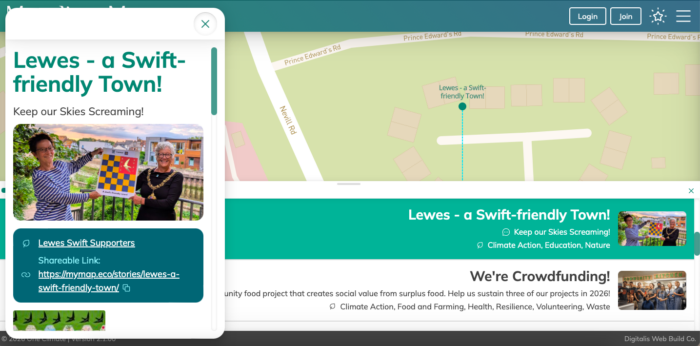
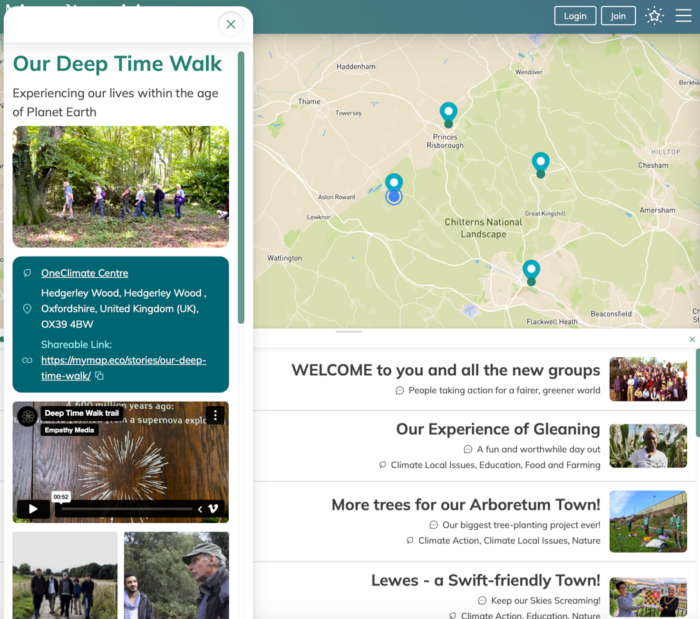
There is a third factor that makes actions relatable and inspiring: stories. People experiencing the ups and downs of bringing their climate or nature project into being are compelling (‘They didn’t have much spare money or time to do climate actions either – but they managed it…’). Stories that speak empathically, including vulnerability, lead to connection far more than slick ‘success’ stories.
In the short term, the Mycelium Map will:
- Increase the visibility of community-led climate and nature actions, making it easy for people to discover what is happening near them.
- Enable community groups to learn from one another more quickly, reducing duplication and accelerating good practice.
- Reduce climate distress triggered by feelings of powerlessness and isolation.
In the long term, the Map will provide vital infrastructure to the climate movement, as it will:
- Become the UK’s largest searchable database of community-led climate action stories, retrievable by theme, place, organisation and date.
- Act as a powerful engine for sustained behaviour change, by embedding climate action into everyday activities and interests.
- Strengthen civic confidence and contribute to the social conditions needed for bolder policy and legislative action.
- Generate aggregated evidence of community-level climate and nature impact through a live dashboard of quantified outcomes. For example, a typical repair café diverts around 50 kg of waste per year from landfill. If 500 repair cafés participate in the Map, the platform can report an estimated 25 tonnes of waste prevented from landfill annually, helping inspire replication and participation.
We need the Mycelium platform with its network of networks to help climate learning about adaptation and mitigation to ripple out across the nation, suffusing the wider culture and normalising climate action. You can watch a short introductory video here.
Map leadership
- Peter Armstrong – Mycelium Map Co-Director (Technology)
Peter is a BAFTA Platinum Award winner for Interactive Media, and the initiator and director of the BBC Domesday Project. He was co-founder and Technical Director of OneWorld, and directed BBC2’s Global Report, a groundbreaking documentary series on global justice.
- Anuradha Vittachi – Mycelium Map Initiator and Co-Director (Content)
Anuradha is an LSE Global Pioneer Award winner for innovating media for social justice. She served as the UK’s civil society delegate to the G8 Summit taskforce on closing the digital divide, co-founded OneWorld, and is the author of Earth Conference One: Sharing a vision for our planet, with a foreword by James Lovelock.
In Phase 1, the Map went live in Oxfordshire and environs, with an organisational layer and an events layer. We hoped to attract 100 organisations on board in the first year. In fact, over 300 organisations joined in 10 months.
In Phase 2, we will be adding a stories layer – and extending the Map nationwide.
In sum
The Mycelium Map is a community-led, storytelling platform connecting people to climate and nature actions. It is a searchable, multimedia platform for self-identified community groups and networks to share myriad practical actions and stories relating to every season of everyday life. By making these actions visible and relatable, the Map enables mutual learning, inspiration and helps mobilise the public to undertake sustained behaviour change. It functions like a living mycelial system: its parts interconnected, interdependent and self-renewing.
How to put your group on the map
It’s as simple (and quick) to join as making a cup of tea.
- Click the Join button at the top of www.mymap.eco
- Create your user profile
- Create a minimal group profile (you can add to it later)
That’s it! Now you’re ready to add your group’s events and stories as they come along.
If your group is interested in becoming part of the map, please email Anuradha Vittachi at anuradha@hedgerleywood.org