

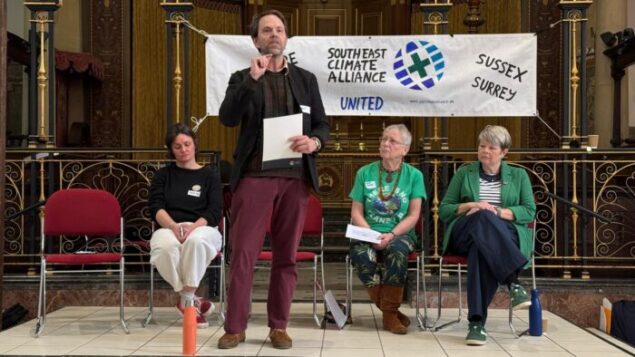
One of the twin themes of this year’s SECA Annual Gathering was climate adaptation and resilience, exploring how we can prepare for climate shocks, protect nature and create resilient communities. This blog by Tony Whitbread outlines the issues and summarises the day’s discussions
Strategic adaptation for emergency resilience – making climate adaptation mainstream
We are now living in the future that we have been warned about. Climate change and nature depletion are upon us, and we are living with the consequences. We now need to be realistic about facing a future that has changed.
Reversing climate change and restoring nature are still top priorities but as a society we also need to adapt to the environmental changes that are upon us.
Rupert Read, Director of the Climate Majority Project, told the SECA Annual Gathering on 28 March that we are discovering what it is like to be dependent on a “clapped-out fossil fuel economy”. You can watch a video of his speech here. Reports and government documents stressing the urgency of the issue are getting increasingly difficult to hide. Read encouraged us to follow the National Emergency Briefing and its campaign to raise awareness of the crisis, and to watch the ITV report on the government’s Global Biodiversity Loss, Ecosystem Collapse and National Security Report.
The implications are shocking: “Every critical ecosystem is on the pathway to collapse,” Read said. But he stressed “The time is now for those of us who are willing to step into the urgency of this moment”. We have to become more resilient and adapt to the changes that are upon us. What this means in practice is laid out in the Climate Majority Project document SAFER – Strategic Adaptation for Emergency Resilience.
Strategic adaptation promotes precaution and transformation rather than crisis response. It can foster climate awareness and agency in communities, counteract political opportunism, build resilience at local levels and ultimately mobilise public support for system change. The Gathering broke into discussion groups where we investigated the reality of what this means.

For business resilience, discussion centred on developing circular rather than extractive approaches, moving away from growth and towards people, planet and prosperity. For energy resilience the focus was on energy efficiency and non-fossil fuel energy generation in balance with nature. Trusted cooperative ventures were promoted, bringing agency back to local level.
With food, a return to local, small-scale production was discussed, better use of allotments and local redistribution linking growers with surplus to people with need.
Resilience in nature would be enhanced with better connectivity between wildlife areas with ecological networks enabling species migration and habitat evolution. Nature based solutions were also considered key when developing more flood resilience. This would also enhance nature resilience and water resources. Poor infrastructure, weak governance and lack of accountability threaten water resources but a recent upsurge in public awareness and citizen science is applying pressure for change.
Emergency response to flood, fire, heat, cold and systems failures with food, water and health systems were discussed by one group. There are some local emergency response plans, these are variable in quality but at least show that some locations are taking the issue seriously.
Resilience to extremes of heat and cold will become major issues in our now unstable climate so citizens and communities will need to find ways to build resilience. Strong communities supporting vulnerable people by providing refuge warm or cool spaces will increase resilience and again the role of nature based solutions in moderating extremes was discussed. Full notes from this session are also available here.
The climate and nature emergency can seem overwhelming, leading to a sense of hopelessness, or to deflection and denial rather than facing up to the issue. The workshop looking at inner resilience was particularly popular, suggesting a strengthening of community and working collectively might be an antidote. Connecting with nature and each other are key precursors to positive engagement rather than depression or denial. “What’s ours to do” was a key phrase – we can’t solve everything but focusing on what we can do where we have local agency is a stimulus for positive action and a sense of wellbeing.