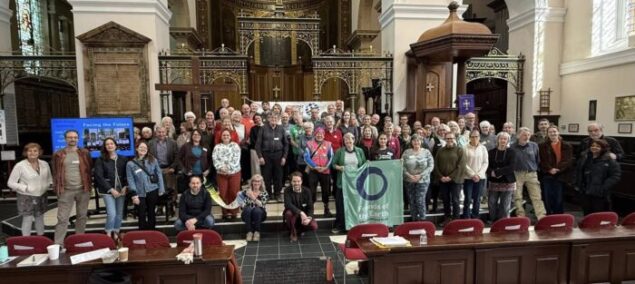
This year’s SECA Annual Gathering took place in Guildford on 28 March with the twin themes of Devolution and Local Government Reorganisation, and Climate Resilience and Adaptation. We came away with energised with plenty of new ideas for campaigning, and this blog by Thalia Griffiths summarises the day’s discussions and gives links to more detailed accounts by other participants
Facing the Future in Guildford!
Around 70 of us came to Guildford on 28 March for the SECA Annual Gathering, with discussions centring around the theme of Facing the Future. Our event faced significant competition from the Together March in London, and we’re grateful to groups who managed to divide their forces between the two.
Opening the plenary session, Victoria Marsom of Friends of the Earth noted that on paper the UK has very strong climate and nature targets but delivery is variable, with strong progress in some areas while others are stuck or even going backwards. While we need to ensure a strong national plan for the UK’s Seventh Carbon Budget, we also need to remember that it is local decisions that shape how we live and how quickly we can restore nature, and these local decisions are being reshaped now by devolution and local government reorganisation. While the topic may sound dry, she said, “the outcomes are really important, it’s about who gets power, who gets the budget, whose priorities shape the future of our communities.” She added: “If climate and nature is not built in, to these new structures from the start, we risk locking in high carbon, nature damaging choices for years, generations.”
Chris Holloway of Hampshire Climate Action Network picked up this point, arguing that if we wait until the new local government institutions are in place it will be too late. “We need to take advantage now so that when systems are rolled out, climate and nature are absolutely embedded in them.”
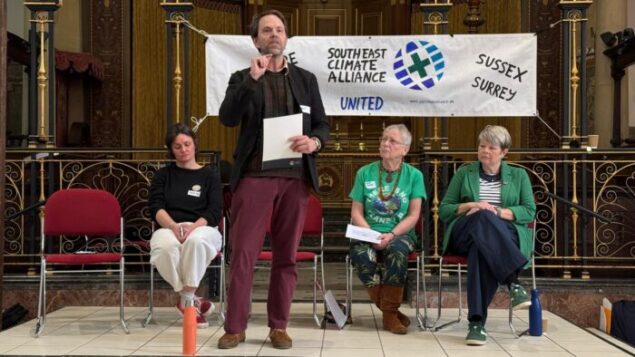
Rupert Read of the Climate Majority Project (CMP) made an impassioned speech arguing that the conflict in the Middle East underlined our vulnerability but we could turn the catastrophe of war into a great opportunity to press for action. “We are the people whose time has come because right now the world is seeing in real time what it means to be dependent on a clapped out fossil fuel economy,” he said. “We have to become more resilient. We have to adapt. The time when we could avoid taking those things seriously is in the past. The time is now for those of us who are willing to step into the urgency of this moment.”
What this means in practice is laid out in the CMP document SAFER – Strategic Adaptation for Emergency Resilience. The CMP aims to shift people’s understanding of climate from something remote and scientific to something that’s about where they live and their community. “When people start to understand that there is stuff they can do and start to get together and build food resilience or water resilience or emergency preparedness then they start to get into a virtuous circle of feeling ‘actually I’m not alone any more’,” he said. “It builds agency.”
He urged us to use the “incredible opportunity” of the hundreds of National Emergency Briefing film showings around the country to get together a group of concerned people and discuss what can be done at a local level.
“People all over the country and all over the world are waking up to the fact that we cannot outsource this to politicians any longer. We have to start preparing ourselves where we live for what is coming.”
You can watch a recording of his speech here, and read a summary of the day’s Climate Resilience and Adaptation sessions by Tony Whitbread here.
Devolution focus
The other theme of the gathering was Devolution and Local Government Reorganisation, where the session divided into groups focusing separately on Hampshire and Sussex, and on Surrey.
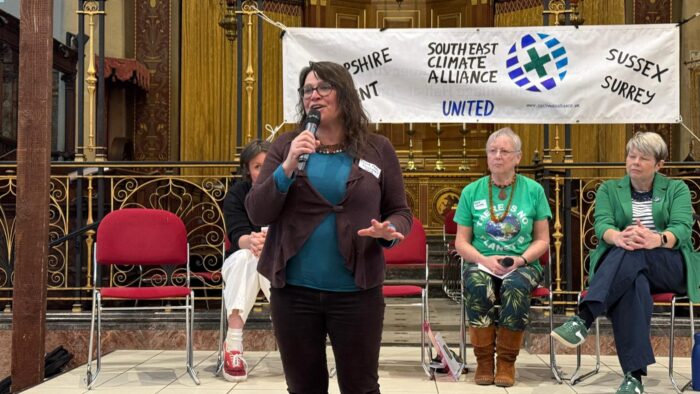
Marta Zietkiewicz of Surrey Climate Commission introduced the Our Future Surrey pledge campaign to the plenary session and with Jacquetta Fewster led a Surrey-focused practical workshop on how to lobby politicians, including working on ‘elevator pitches’ to engage canvassers coming to the door.

The Sussex and Hampshire workshop looked at how community groups can work together to build public pressure on our future Mayors and Unitary Authorities to make climate and nature a priority. You can read a summary of their discussions and recommendations by Sally Barnard here.
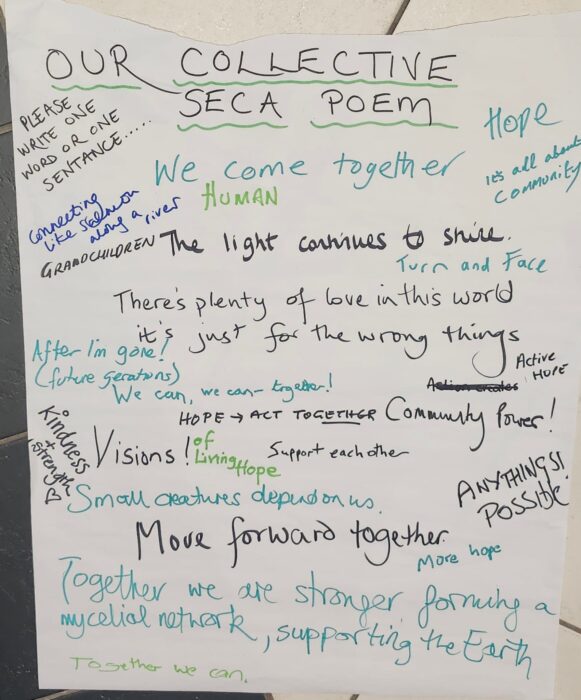
Nicola Peel invited us to create a collective poem by writing a word or phrase on a flip chart, and she read our poem at the end of the day. You can watch a recording from the Horsham Eco Churches Facebook page here.